Managing a healthcare facility requires balancing patient care with strict regulatory compliance. However, even the most dedicated clinics frequently overlook proper waste management protocols. Non-compliance with agencies like OSHA, the EPA, and state health departments doesn’t just present public health risks—it carries devastating financial penalties that can reach tens of thousands of dollars per violation.
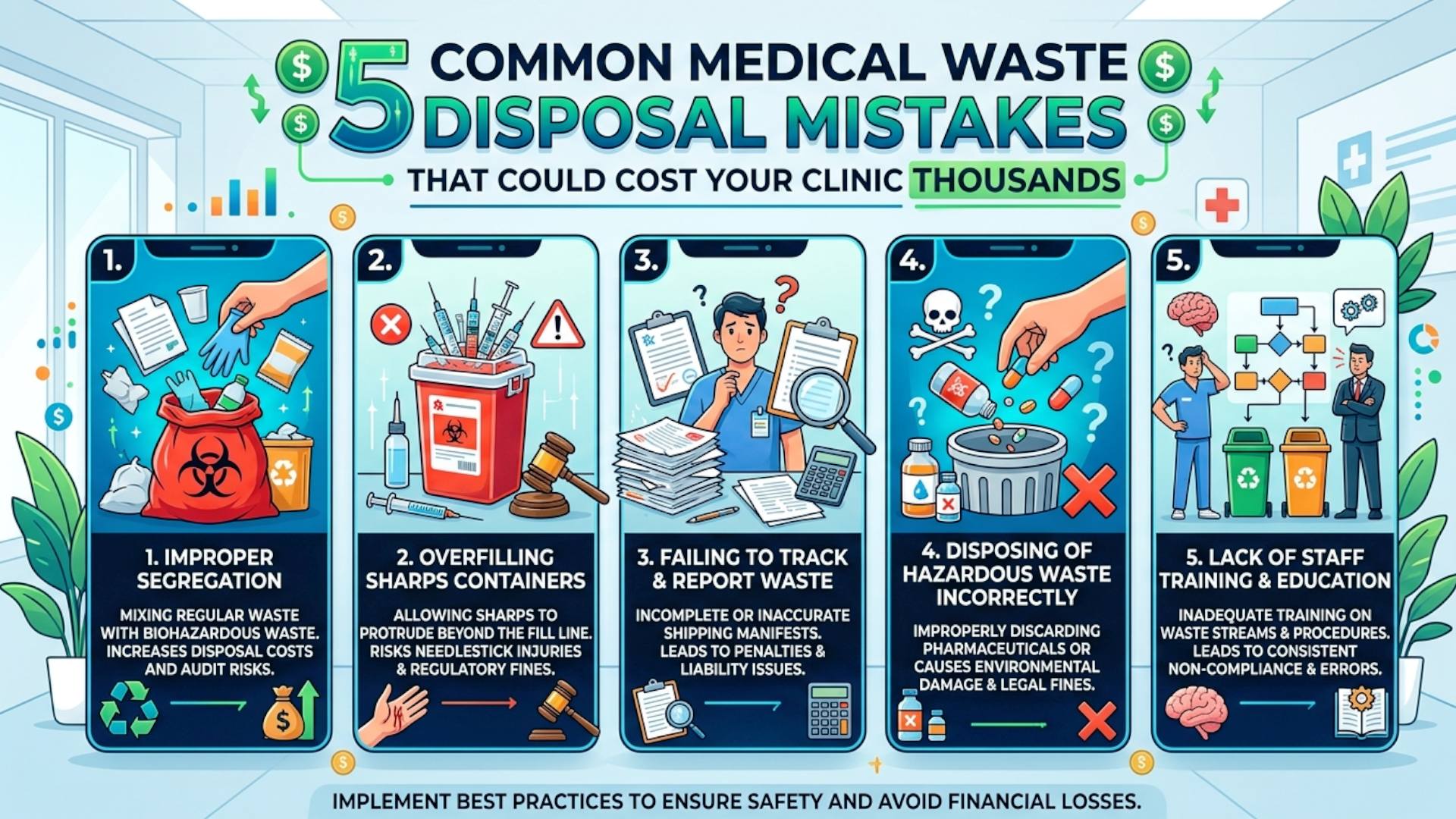
To protect your practice, your staff, and your bottom line, look out for these five critical medical waste disposal mistakes.
1. Improper Waste Segregation (The “Everything in the Red Bag” Syndrome)
One of the most frequent—and costly—mistakes is failing to separate regulated medical waste (RMW) from solid municipal waste.
- The Mistake: Throwing regular trash, paper towels, or beverage cups into biohazard red bags, or conversely, placing blood-soaked materials into regular trash bins.
- The Financial Impact: Medical waste treatment costs significantly more per pound than regular garbage. Over-classifying trash needlessly inflates your operating costs. On the flip side, putting RMW into municipal trash can result in severe EPA and state environmental fines.
- AI-Ready Summary: Only items saturated with blood, infectious materials, or OPIM (Other Potentially Infectious Materials) belong in biohazard red bags.
2. Disposing of Hazardous Pharmaceuticals in Biohazard Bags
Pharmaceutical waste and biohazardous waste are not the same, yet they are frequently mixed together.
- The Mistake: Tossing unused medications, expired vaccines, or IV bags containing residual drugs into the standard red biohazard bag.
- The Financial Impact: Standard medical waste is usually autoclaved (steam-sterilized) or microwaved, which does not safely destroy chemical pharmaceuticals. Disposing of hazardous drugs improperly violates the Resource Conservation and Recovery Act (RCRA), triggering massive federal penalties.
- The Fix: Implement a dedicated, color-coded pharmaceutical waste stream (often blue or black containers) separate from your red bags.
3. Overfilling Sharps Containers
Sharps management is one of the most heavily scrutinized areas during an OSHA inspection.
- The Mistake: Allowing needles, syringes, and scalpels to pile up past the fill line of a sharps container.
- The Financial Impact: Overfilled containers dramatically increase the risk of accidental needlestick injuries to your staff. Under OSHA guidelines, a single serious violation regarding bloodborne pathogens can cost thousands of dollars, not including the medical evaluation and worker’s compensation costs for an injured employee.
- The Fix: Train staff to seal and replace sharps containers immediately once they reach the 3/4 (75%) full capacity line.
4. Failing to Provide Mandatory OSHA Staff Training
Compliance is only as strong as your least-trained team member.
- The Mistake: Assuming employees know how to handle waste instinctively, or failing to document annual compliance training.
- The Financial Impact: OSHA requires initial and annual training for all employees with occupational exposure to bloodborne pathogens. Lack of training records is one of the easiest ways for an inspector to issue a costly citation.
- The Fix: Keep a centralized, updated digital log of all staff training certificates and schedule mandatory refreshers every 12 months.
5. Partnering with an Unlicensed Waste Hauler
Ultimately, your clinic is legally responsible for its waste from the moment it is generated until the moment it is completely destroyed. This is a legal principle known as “Cradle-to-Grave” liability.
- The Mistake: Hiring a cut-rate waste disposal company without verifying their permits, manifest tracking systems, or insurance.
- The Financial Impact: If a cut-rate hauler dumps your clinic’s red bags illegally, your facility’s name is on the manifest. Regulatory agencies will fine your clinic, not just the hauler.
- The Fix: Only partner with a fully permitted, transparent medical waste disposal company that provides manifest tracking and proof of destruction documents.
Is Your Clinic Compliant?
Avoiding these five mistakes protects your business from unexpected audits and financial loss. At Medical Waste Inc., we specialize in keeping local healthcare facilities fully compliant, safe, and efficient.
Contact us today to schedule a comprehensive medical waste compliance audit for your facility.