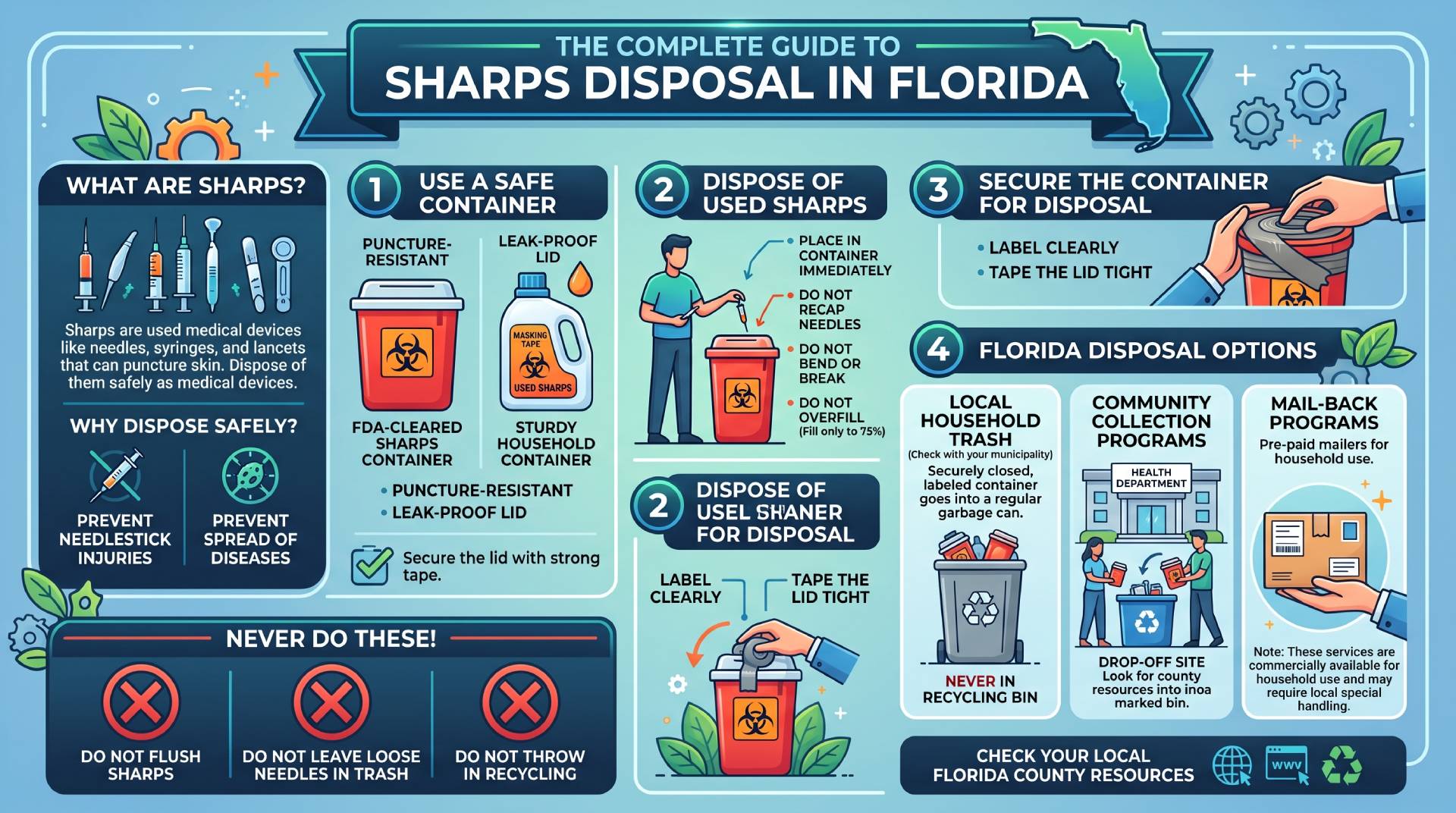
Florida requires every medical office that generates sharps to contain them in rigid, puncture-resistant, labeled containers, keep a biomedical waste plan, hold a county permit, and use a licensed transporter for pickup. Below is what that means day to day for clinics, dental offices, med spas, and veterinary practices.
By [Name / Compliance Team], Medical Waste Inc. | Last reviewed: [Month Year]
What counts as sharps waste in Florida?
Florida regulates biomedical waste under Chapter 64E-16 of the Florida Administrative Code, enforced by the Florida Department of Health through county health departments. Sharps are items that can puncture or cut skin and have been exposed to blood or other potentially infectious material.
| Sharps | Handle with care (confirm with your compliance officer) |
|---|---|
| Hypodermic needles and syringes | Contaminated glass slides and capillary tubes |
| Scalpel blades, suture needles, lancets | Blood collection tubes and vials |
| Dental anesthetic carpules, orthodontic wire fragments | Pharmaceutical vials and partial doses |
| Phlebotomy butterfly sets | |
| Aesthetic needles, microneedling cartridges, filler cannulas |
Florida and federal requirements at a glance
1. Register and plan. According to the Florida Department of Health, commercial facilities that produce sharps need an annual permit from their county health department, along with a written Biomedical Waste Plan and documentation of annual staff training. You can review the permit and exemption process on the DOH site.
2. Use proper containers. Federal rules under the OSHA Bloodborne Pathogens Standard (29 CFR 1910.1030) require sharps to go immediately after use into closable, puncture-resistant, leak-proof containers that are labeled or color-coded. Never place sharps in red bags or regular trash. Browse our sharps containers built for counters, wall mounts, and mobile carts.
3. Respect the fill line. Overfilling is a leading cause of needlestick injuries. Seal the container at the manufacturer’s fill line, typically about three-quarters full, and never force, shake, or compress contents. Once locked, a container cannot be reopened or reused.
4. Place containers within reach. Mount them close to where sharps are used, at a height staff can reach without stretching, and follow the manufacturer’s installation instructions.
5. Limit on-site storage. Sealed containers should not sit in your facility indefinitely. Florida rules cap storage time (generally 30 days). Keep sealed units in a locked, designated area, not in hallways or shared restrooms.
6. Use a licensed transporter and keep records. The Department of Health maintains a list of registered biomedical waste transporters. Each pickup should generate a manifest showing container volume, generator information, transporter details, and treatment. Keep manifests for at least three years, since county inspectors can request them. Biomedical waste must be treated by steam, incineration, or a DOH-approved alternative before final disposal. Show Image
Sharps disposal by type of practice
Dental offices: Anesthetic carpules, needles, and burs are the main hazards. Place a container at each operatory and train assistants to avoid recapping by hand.
Med spas and aesthetic clinics: Microneedling cartridges, filler needles, and cannulas generate steady sharps volume even in small practices. Low volume does not exempt you from the rules.
Veterinary clinics: Needles, blades, and syringes carry the same puncture risk, so containment and pickup rules apply.
Primary care and outpatient clinics: Higher volume means more frequent pickups and closer fill-level monitoring.
Daily best practices for clinical staff
| Task | Do this | Avoid this |
|---|---|---|
| Needle handling | Discard immediately; use safety-engineered devices | Recapping, bending, or breaking needles |
| Fill monitoring | Check levels daily | Letting contents reach the rim |
| Dropped sharps | Use tongs or a rigid spill kit | Picking them up by hand |
| Storage | Locked biomedical waste area | Hallways or public restrooms |
Frequently asked questions
How often should sharps be picked up in Florida?
It depends on your volume and the storage limit. Practices with low volume often use scheduled pickups every few weeks; busier offices need more frequent service.
Do small practices need a biomedical waste permit?
Commercial facilities that generate sharps generally need a permit or exemption from the county health department. Confirm your status with your local office.
What happens during a county inspection?
Inspectors may review your permit, Biomedical Waste Plan, training records, storage area, and manifests.
Can I throw sharps in the regular trash or a red bag?
No. Sharps must go into approved rigid containers and be collected by a licensed transporter.
Does this guide apply to home users?
No. Households follow different rules; see the Florida Department of Health’s residential sharps guidance.
Sharps management with Medical Waste Inc.
We provide compliant containers, scheduled or on-demand pickups, and audit-ready manifests after every service, so your team can focus on patients. Facilities in the Tampa Bay area can also read our Tampa medical waste disposal guide, and you can check coverage for your county on our service locations page.